
Nikro Air Duct Cleaning in Crabtree: A Homeowner’s Guide
Most homeowners judge air duct cleaning by price and by reviews. Almost nobody asks what vacuum system is actually sitting outside the house. That single question predicts the outcome better than any coupon, because a weak vacuum cannot remove what has bonded to the duct walls no matter how long the technician works. Nikro Industries builds equipment to contractor-grade specifications, and understanding what those systems do inside a Crabtree duct explains why two “duct cleaning” jobs can produce wildly different results.
If you’d rather not sort through the equipment question yourself, call (833) 509-5534. We answer 24/7. Fast dispatch from 7am to 7pm, Sunday through Friday.
Key Takeaways
- Source removal depends on pressure differential, not brushing alone. The vacuum has to hold negative pressure while the agitation happens.
- Nikro builds both portable and truck-mount negative air machines, and the right choice depends on your Crabtree home’s layout and duct run length.
- Equipment brand is only half the story. A Nikro system run by an untrained hand underperforms a lesser machine run correctly.
- Cleaning without repair and sealing leaves gaps that let contamination back in.
What does Nikro Industries actually make, and who uses it?
Nikro Industries manufactures vacuum and agitation equipment for the restoration, abatement, and air conveyance trades. Their catalog runs from HEPA-rated vacuums and negative air machines to rotary brush tooling and collection systems. The market segment matters here: Nikro equipment shows up in commercial restoration work, mold remediation, and asbestos abatement, trades where a failed vacuum means a contaminated building and a failed inspection.
That’s a different customer than the residential coupon-cleaning market. A restoration contractor can’t afford a vacuum that stalls mid-job or lets fine particulate escape back into the room, so the equipment gets built to a spec that reflects real consequences. When the same class of machine appears in a residential duct cleaning operation, it tells you something about how the contractor thinks about the work.
In our experience, homeowners in Crabtree rarely get to see the equipment before it arrives. Asking two questions up front fixes that. What vacuum system will be on site? Is it HEPA-rated, and to what particle size? A contractor who can answer both without hesitating is usually the one worth hiring. One who answers with a brand name and nothing else is telling you they don’t know their own tools.
We run Nikro HEPA-rated vacuum equipment alongside Rotobrush rotary brush systems, which is the same equipment pairing commercial restoration crews rely on. Your home deserves that standard too.
How does negative air pressure make duct cleaning work?
Duct cleaning works on a simple principle: put the duct under negative pressure, then disturb everything stuck to the walls, and the contamination travels toward the vacuum instead of into your living room. The pressure differential is the whole job. Brushing without it just moves dust around.
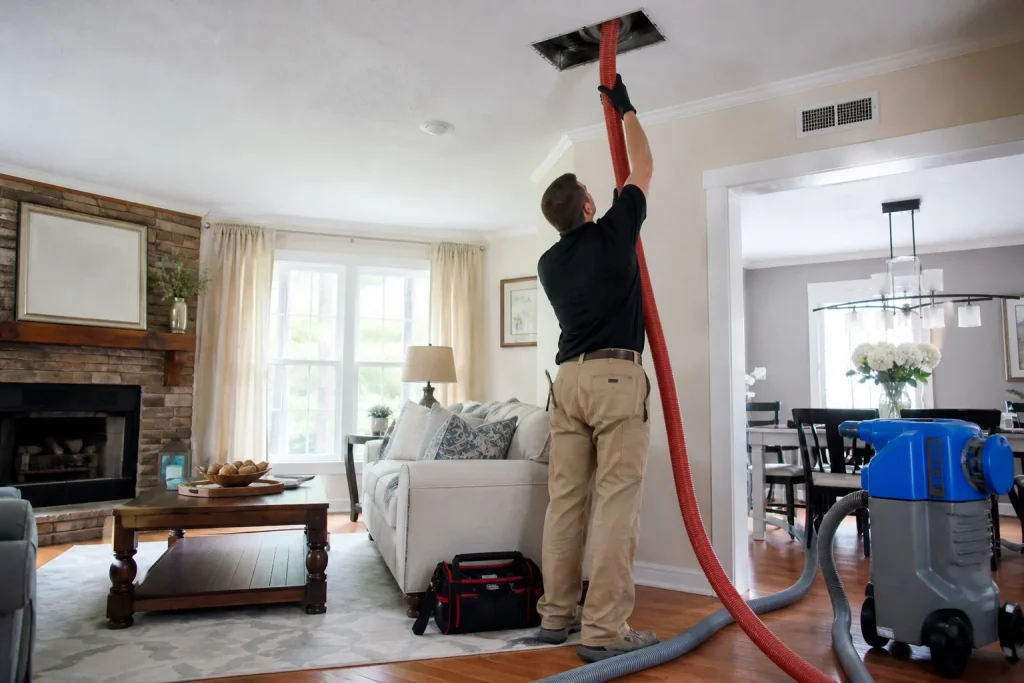
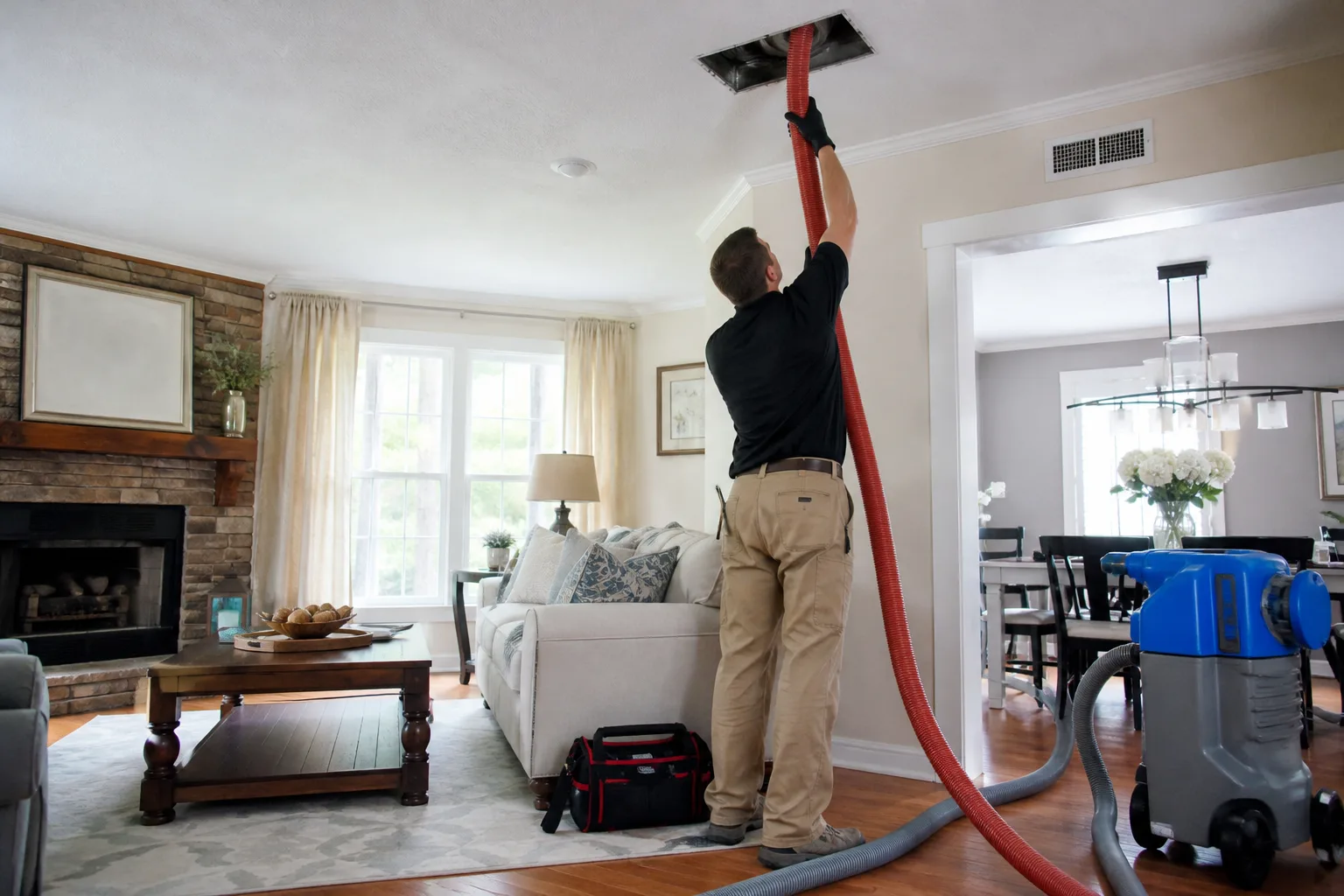
Here’s what that looks like in practice. The technician connects a high-volume vacuum to the main trunk and seals the connection so the system can hold pressure. Then, working from the farthest branch back toward the vacuum, they agitate the duct walls with a rotary brush or air whip. Every loose particle gets pulled toward the collection point because the pressure never drops. If the vacuum is undersized or the seal is sloppy, pressure leaks and the dislodged dust settles right back where it started.
Why filtration matters as much as suction
Suction alone isn’t enough when the exhaust air is headed back into your home. That’s why we deploy Abatement Technologies air filtration during a job, capturing what we dislodge before it recirculates into the rooms your family is standing in. A vacuum that pulls debris out of a duct and blows the fine fraction into a hallway hasn’t cleaned anything.
This is where cheap equipment shows its limits. A shop vacuum rated for sawdust can move air, but it can’t hold a HEPA-grade seal on fine particulate. For Crabtree homes with allergy sufferers or musty odors, the difference between a properly filtered job and a fast one is the difference between an answer and a repeat visit.
Portable or truck-mount: which Nikro setup fits a Crabtree home?
Truck-mount units generate far more suction and airflow than portable machines, and they’re the right call for long duct runs, large square footage, or heavy contamination. Portable negative air machines are the better fit for tighter homes, crawlspace and attic layouts, and jobs where the truck can’t park close enough to run hose. Neither is automatically better. The right choice depends on the house.
Crabtree homes vary enough that this isn’t a theoretical question. A single-story ranch with a short trunk line and easy attic access is a different job from a two-story with a long trunk run and a cramped mechanical closet. Ask a contractor how they’ve sized the vacuum for your specific layout. A competent answer will reference duct length, number of branches, and where the equipment will physically connect.
- Truck-mount is the fit for: long trunk runs, larger homes, heavy dust or pet hair accumulation, and multiple systems.
- Portable negative air is the fit for: limited parking access, tight mechanical spaces, single-system homes with short runs, and jobs where hoses can’t reach from the street.
- Either way, ask: what’s the airflow rating, and how do you maintain the seal at the connection point?
A contractor who shows up with one setup and uses it regardless of the house is telling you they’ve standardized on convenience. That’s a warning sign. The equipment should follow the house, not the other way around.
What should a technician be doing during a Nikro-equipped job?
The equipment enables a process, and the process is what you’re actually paying for. Here’s the sequence a competent operator runs, and what each step looks like from where you’re standing.
- Inspection first. Before any hose goes on, the technician checks duct integrity, looks for disconnected joints, and confirms the system type. Cleaning a duct system with a broken joint just blows debris into a wall cavity.
- Seal and connect. The vacuum connects to the main trunk with a sealed collar. Ask to see the seal. If air is whistling out around the connection, the pressure differential is compromised.
- Agitate from the far end back. Rotary brush or air whip works each branch, starting farthest from the vacuum and moving inward. This is where the visible dust load comes out.
- Filtration running throughout. Air scrubbers should be operating for the whole job, not just at the end.
- Verify, then repair. The technician confirms airflow at the registers and addresses any joints that need sealing before the job closes out.
Notice that cleaning is only part of the job. We repair and seal ducts so the system stays clean after we leave, because a sealed system doesn’t pull attic air or crawlspace dust back into the supply path. Most duct cleaners stop at step four. That’s the gap that brings contamination back within a season.
When to call a pro instead of watching from the sidelines
Some of this you can check yourself: look at your return registers, feel for airflow at each supply vent, note whether certain rooms run hot or cold. But the moment you’re dealing with musty odors that return after cleaning, visible dust streaking around a register, or a system that hasn’t been touched in years, it’s time to stop inspecting and start booking. Duct interiors, mechanical connections, and negative pressure setups aren’t a homeowner job.
Why does equipment quality still depend on technician training?
A Nikro system operated incorrectly underperforms a lesser machine run by someone who knows what they’re doing. This is the part most homeowners miss. The equipment sets the ceiling on what’s possible; the technician determines how close to that ceiling the job actually gets.
Common failure modes we’ve seen with good equipment in the wrong hands: running the vacuum without a proper seal so pressure never builds, brushing too fast through a branch instead of letting agitation do its work, skipping the farthest runs because they’re awkward to reach, and treating the whole job as a visual pass at the registers. None of that is an equipment problem. All of it produces a job that looks finished and isn’t.
What to look for beyond the brand name on the unit:
- Does the technician inspect before connecting anything?
- Do they show you before-and-after photos of your own ducts, not stock images?
- Do they explain the pressure setup in plain terms?
- Do they flag joints that need sealing, or just clean and leave?
- Is the price a flat rate per system agreed before work starts, or does it shift once they’re on site?
Our technicians have up to 11 years of experience, and the equipment only counts for something because of it. The brand gets the vacuum to your door. The training is what makes it worth the visit.
Related services in Crabtree: if dust and odors are only part of the picture, it’s worth pairing the duct work with dryer vent cleaning, which handles a separate ventilation path that lint builds up in over time. And if your HVAC unit itself hasn’t been cleaned in years, HVAC cleaning covers the coil and blower side of the system, not just the ductwork.
The Bottom Line
Nikro equipment matters because source removal depends on holding negative pressure while you agitate, and that’s a machine specification, not a marketing claim. In Crabtree, the right setup depends on your home’s layout: truck-mount for long runs and heavy contamination, portable negative air for tighter spaces and limited access. And the equipment only performs to its rating when a trained technician runs the process correctly, inspects first, seals properly, and finishes with duct repair and sealing so the system stays clean.
When you ask for a quote, ask what vacuum system will be on site, whether it’s HEPA-rated, and how the connection gets sealed. The answers will tell you more than the price will.
If you’re in Crabtree and need help, Air Duct Cleaning Crabtree offers free estimates. Give us a call at (833) 509-5534. We answer 24/7. Fast dispatch from 7am to 7pm, Sunday through Friday. You can also start with our Air Duct Cleaning Crabtree page or read more about air duct cleaning before you book. One flat price per system, agreed before work starts, with before-and-after photos of your own ducts.
Frequently Asked Questions
It means the contractor uses Nikro Industries vacuum and negative air equipment rather than consumer-grade machines. In practice, that translates to a system that can hold pressure across your full duct run while the technician agitates the walls, with HEPA-rated filtration capturing fine particulate instead of recirculating it. Ask any contractor what vacuum system they’ll use and whether it’s HEPA-rated. Call (833) 509-5534 for an exact quote on your home.
Often, yes, because Nikro builds for restoration and abatement contractors where a vacuum failure has real consequences, while many residential services use lighter-duty or consumer equipment. But equipment brand alone doesn’t guarantee a good job. A trained technician running a mid-range machine correctly will outperform an untrained one running a premium unit. Ask about both the equipment and the process. Estimates are free, so call (833) 509-5534 and ask.
Cheap quotes usually reflect one of three shortcuts: a smaller vacuum that can’t hold real pressure, no filtration during the job, or per-vent pricing that starts low and climbs once the technician is inside. A whole-system price agreed before work begins is the honest structure, and it costs more upfront because it reflects the actual scope. Ask what’s included before you compare numbers. Call (833) 509-5534 for a flat price on your system.
Ask for before-and-after photos of your own ducts, not stock images. A technician running proper equipment should also be able to show you the connection seal at the trunk, explain the pressure setup, and report which joints needed sealing. If a contractor can’t show you any of that, you’re taking their word for it. Call (833) 509-5534 and we’ll walk you through what a job includes before you commit.
Written by the team at Air Duct Cleaning Crabtree.
Need Air Duct Cleaning Help?
Call Air Duct Cleaning Crabtree - the local pro we connect you with is licensed and insured, with free written estimates in Crabtree.
(833) 509-5534