
Air Duct Cleaning: Repair or Replace? How Crabtree Homeowners Decide
Most Crabtree homeowners call about duct cleaning because something feels wrong – dust that returns too fast, rooms that never warm up, a musty smell when the system kicks on. Before you book anything, though, there’s a more important question: is your ductwork sound enough to be worth cleaning? If your ducts are leaking a significant share of conditioned air into an unconditioned attic or crawl space, cleaning them without repairing them first is like scrubbing a leaky bucket. It comes out clean. It still doesn’t hold water.
Here’s the short answer. Cleaning fixes contamination. Repair fixes performance. If you have active leakage, crushed flex duct, or a liner that’s breaking down, repair comes first – or the money you spend on cleaning buys you a temporary improvement at best.
If you’d rather have someone look at the system than climb into the attic yourself, call (833) 509-5534.
Key Takeaways
- Duct cleaning removes contaminants. It does not fix leaks, crushed runs or failing liner.
- Three conditions mean repair comes before cleaning: active leakage, collapsed or kinked flex duct, and a shedding internal liner.
- A duct leakage test gives you a percentage before you spend money, so you’re not guessing.
- Sealing plus cleaning often costs less than replacing duct runs, and it solves the problem cleaning alone can’t touch.
- Get a whole-system assessment first. Then decide the order of work.
What’s the Difference Between Cleaning, Repair and Replacement?
Cleaning, repair and replacement solve three different problems, and confusing them is the most common way Crabtree homeowners waste money on ductwork.
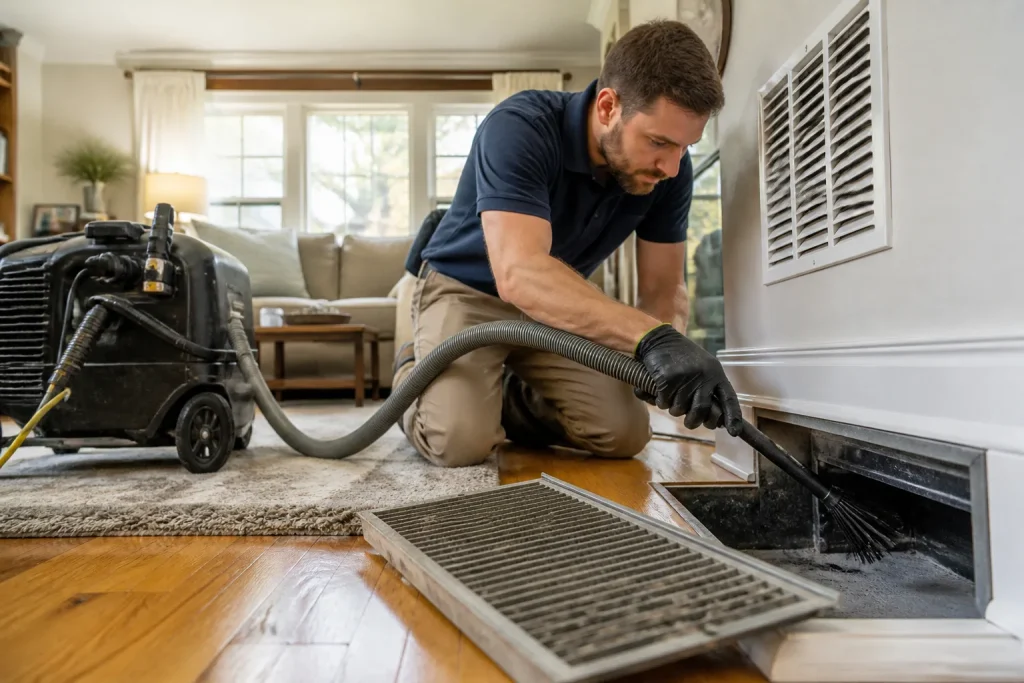
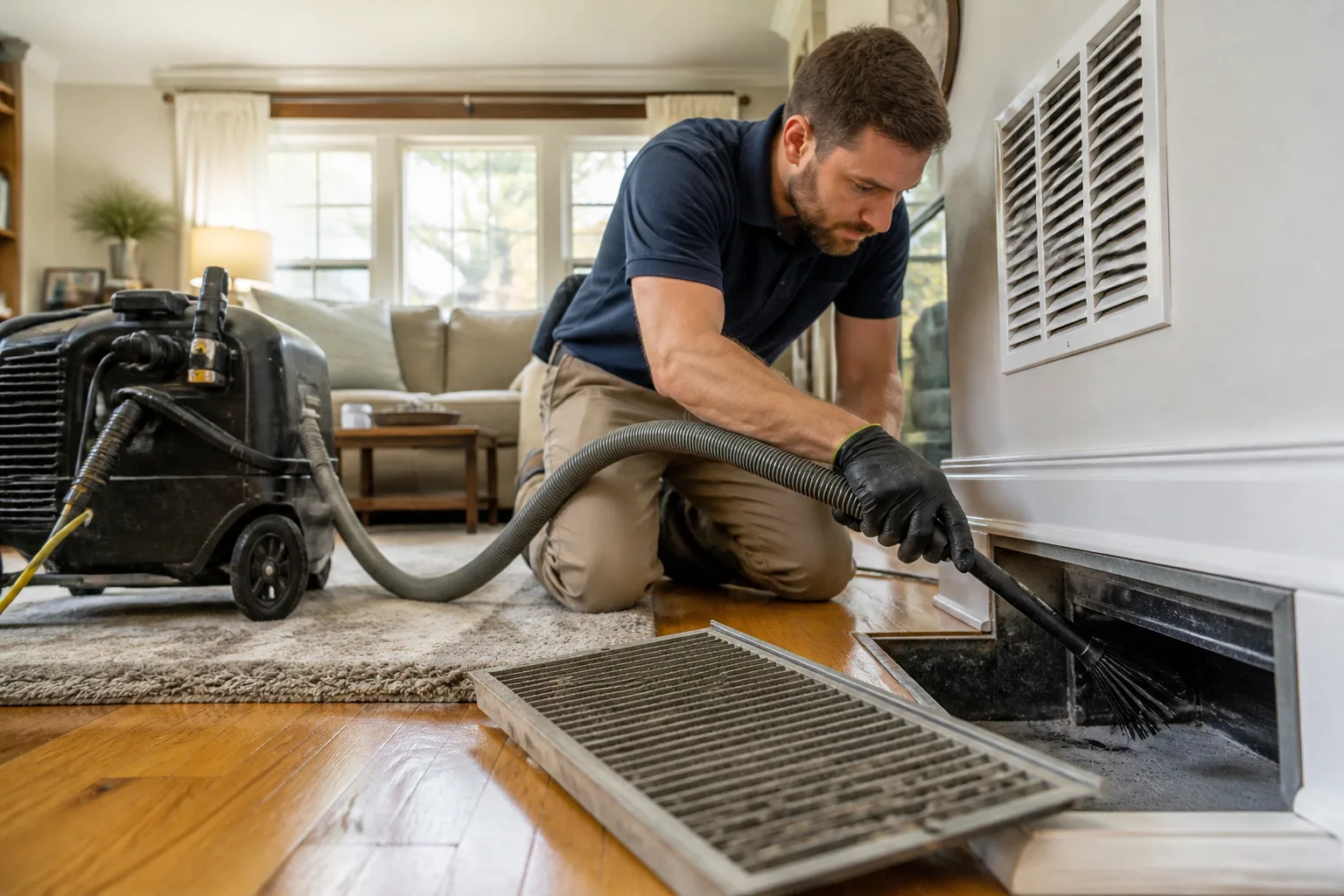
Cleaning removes what’s inside the ducts: settled dust, debris, dander, microbial growth on damp surfaces. We do this with Rotobrush rotary brush systems and Nikro HEPA-rated vacuum equipment that captures particles down to 0.3 microns, with Abatement Technologies air scrubbers running throughout the job so what we dislodge doesn’t recirculate into your living space.
Repair addresses the physical condition of the duct system. That means sealing leaks at joints, boots and plenum connections; reconnecting disconnected runs; replacing crushed sections; and addressing liner that’s peeling or shedding.
Replacement is what happens when a section of duct is beyond repair – a run so collapsed, contaminated or degraded that cleaning it accomplishes nothing.
- Cleaning answers: what’s in my ducts?
- Repair and sealing answers: is my duct system losing air or pulling contamination in?
- Replacement answers: is this section of duct too far gone to fix?
For a plain look at air duct cleaning as a standalone service, that page covers what a standard visit involves. The point here is narrower: when cleaning alone isn’t the right first move.
When Should Ducts Be Repaired Before They’re Cleaned?
Repair comes before cleaning when the duct system has a structural problem that would make cleaning temporary or pointless. In our experience, three specific conditions call for that sequence.
- Active duct leakage. When supply ducts run through an unconditioned attic or crawl space, every leak pushes conditioned air outside the envelope and pulls unconditioned air back in. Cleaning a leaking system means you clean the ducts, then immediately reintroduce dust and humidity through the same gaps. Sealing closes that loop.
- Collapsed or kinked flex duct. A flex run that’s crushed under a joist, kinked at a sharp turn or sagging between hangers restricts airflow to that room. No amount of brushing restores a duct that’s physically pinched shut. It has to be re-run or replaced.
- Deteriorated internal liner. Some older duct board and lined metal ducts have a fiberglass liner bonded to the inside. Once that liner degrades, it sheds fibers into the airstream. Cleaning can make it worse by disturbing material that’s already failing. That duct section needs replacement, not a brush.
Each of these is a physical condition, not a sales pitch. A solid duct system with ordinary dust buildup just needs cleaning. A compromised one needs the leak or the crushed section dealt with first, or the cleaning money gets spent twice.
How Do You Find Out If Your Ducts Are Leaking?
You measure it. Duct leakage testing gives you an actual percentage instead of an opinion, and it’s the single most useful thing a Crabtree homeowner can request before committing to any ductwork.
The standard approach pairs two tests:
- A blower door test measures how leaky the house envelope is overall. It establishes the baseline pressure conditions the duct test needs.
- A duct blaster test pressurizes the duct system itself with the registers temporarily sealed, then measures how much air escapes. The result is expressed as a percentage of total system airflow – which is exactly the number that tells you whether cleaning makes sense on its own.
Ask for the leakage percentage in writing. If a contractor quotes a cleaning without ever measuring the ducts, you’re being asked to spend money on a guess. That’s the pattern that gives this trade its bad reputation, and it’s easy to avoid by asking one question up front: what’s my leakage percentage?
If the ducts come back tight and the complaint is dust, odors or allergy symptoms, cleaning is the right call and you can book it with confidence.
What Does Each Approach Cost in the Crabtree Area?
Cleaning a leaking system, sealing it, or replacing failing runs are three different price brackets, and the cheapest option isn’t always the one that solves the problem. Here are typical estimated ranges for the Johnston County market.
| Approach | Typical Estimated Range | What It Solves |
|---|---|---|
| Cleaning only | $350 – $700 | Contamination inside intact ducts |
| Duct sealing plus cleaning | $1,400 – $2,800 | Leakage plus contamination; restores system performance |
| Partial duct replacement plus cleaning | $1,800 – $4,500 | Collapsed runs, failing liner, unrecoverable sections |
Those ranges are estimates, and they’re whole-system figures rather than per-vent pricing. The written estimate sets the final price before any work starts, so there’s no surprise on the invoice.
Here’s the cost-benefit logic. Cleaning a leaking system at the low end of the range sounds like the budget choice, but if the leaks stay open, the system keeps pulling attic dust and losing conditioned air – and the cleaning benefit fades. Sealing plus cleaning costs more up front and solves both problems in one visit. Partial replacement is for sections where repair genuinely isn’t possible.
Which Duct Systems in Crabtree Homes Are Most Likely to Need Replacement?
Duct age and construction tell you a lot about what to expect. Two configurations show up often in Crabtree-area homes, and both have predictable failure patterns.
1980s and 1990s fiberglass flex duct is the most common candidate for partial replacement. Flex duct is convenient and it doesn’t age well. The outer jacket tears, the inner liner compresses, and runs that were originally pulled tight end up sagging or kinked. In a hot, humid North Carolina attic, the jacket also takes a beating from heat cycling. Once a flex run is crushed or the liner is compromised, replacement is the honest answer.
Early 2000s duct board – rigid fiberglass board fabricated into trunk lines and plenums – tends to fail differently. The board itself is durable, but joints and seams open over time, and the interior surface can degrade where moisture has been present. Sealing handles most of this. Replacement is only needed where the board has softened or the liner is shedding.
The general rule: metal and board duct usually gets repaired and sealed. Flex duct more often gets replaced in sections. An inspection tells you which category your system falls into.
Why Get a Full-System Assessment Before a Cleaning Quote?
A cleaning quote prices one service. A full-system assessment evaluates the whole air pathway and tells you what order the work should happen in. Those are not the same thing, and the difference is where money gets spent in the wrong order.
An assessment looks at duct condition and integrity, leakage, insulation, filtration, the HVAC unit itself, and the humidity picture in the home. That’s how you catch a crushed flex run in the attic before you pay to clean a duct that can’t deliver air anyway.
This is also where filtration upgrades belong. If your system is running a basic filter in a housing that can’t take anything better, that’s worth knowing before the cleaning, not after. We integrate Honeywell and Aprilaire filtration and humidity products into the same service window, so the upgrade happens alongside the cleaning and repair rather than as a separate project.
We also treat HVAC cleaning as part of the same conversation, because the air handler and coil are part of the air pathway. Cleaning ducts while leaving a contaminated coil in place is another version of doing things out of order.
When to Call a Pro
If you’ve noticed musty odors, uneven airflow between rooms, dust that settles back within days, or allergy symptoms that ease when you’re away from home, those are signals worth having inspected. Ductwork in attics and crawl spaces involves confined spaces, insulation, and in some cases electrical components nearby – not a job for a homeowner with a shop vac. A trained technician can measure leakage, inspect for crushed runs, and check liner condition without disturbing hazardous material.
Related Services in Crabtree
Duct repair and sealing is the natural companion to cleaning when leakage is the problem. We also handle dryer vent cleaning as a dedicated service, because ventilation safety across the whole home matters as much as the HVAC side. And if you’re starting from scratch on understanding what a proper visit covers, the Air Duct Cleaning Crabtree main page lays out the full scope.
The Bottom Line
If your ducts are leaking, crushed or shedding liner, repair comes before cleaning. If they’re intact and just dirty, cleaning is the right call and nothing more. The way to know which situation you’re in is a leakage test and a full-system assessment – not a coupon price and a guess.
To sum it up:
- Measure leakage before you spend money on cleaning.
- Seal leaking ducts so the cleaning actually holds.
- Replace flex runs and failing liner sections rather than cleaning around them.
- Address filtration and humidity in the same visit if the system needs it.
Our technicians have up to 11 years of experience, and we use the same equipment commercial restoration crews rely on – Rotobrush and Nikro – because your home deserves the same standard. One flat price per system, agreed before work starts, with before-and-after photos of your own ducts so you can see what was done.
If you’re in Crabtree and need help, Air Duct Cleaning Crabtree offers free estimates. Call (833) 509-5534. We answer 24/7. Fast dispatch from 7am to 7pm, Sunday through Friday.
Frequently Asked Questions
Most whole-system air duct cleaning in the Crabtree area runs an estimated $350 to $700, depending on system size and how many runs are involved. That’s a whole-system figure, not a per-vent price. If sealing or partial replacement is needed, the range moves up to roughly $1,400 to $4,500. Call (833) 509-5534 for an exact quote – estimates are free.
Usually because something is missing – a real leakage test, HEPA-rated equipment, air scrubbing during the job, or the repair work the system actually needs. A low quote often prices only the visible registers and skips the parts of the system you can’t see. The bait-and-switch pattern starts with a number that doesn’t cover the job. Call (833) 509-5534 for an honest range and a written estimate.
Ask for before-and-after photos of your own ducts, taken during the service, and ask for the leakage percentage if a test was run. A contractor who uses Rotobrush and Nikro equipment can show you what came out of the system. If a company can’t document the work, that tells you something. Call (833) 509-5534 to schedule a visit with documentation.
There’s no universal schedule. Most homes benefit from cleaning every few years, but a home with pets, recent renovation dust, or allergy sufferers may need it sooner – and a home with sealed, well-maintained ducts may go longer. What matters more is checking duct integrity first. Call (833) 509-5534 and we’ll help you figure out whether you’re due.
Often not, and that’s the point of this article. Uneven airflow usually traces back to a crushed flex run, a disconnected duct, a damper, or a sizing issue – not to dirt inside the ducts. Cleaning a restricted duct doesn’t restore the airflow. Repair or replacement does. Call (833) 509-5534 to have the system inspected.
Written by the team at Air Duct Cleaning Crabtree.
Need Air Duct Cleaning Help?
Call Air Duct Cleaning Crabtree - the local pro we connect you with is licensed and insured, with free written estimates in Crabtree.
(833) 509-5534